
 English
 Română
Article summary web design: Use and utility, No visual design, determines the success or failure of a website. Because the page visitor is the only person who clicks on the mouse and so decides everything, User-centered design has been established as a standard approach for successful and profit-oriented web design. After all, If users cannot use a feature, could not exist.
We will not discuss the design of design implementation (e.g, where the search box should be placed), as I have already done in several articles; instead, we focus on the main principles, heuristics and approaches for effective web design – approaches that, used correctly, they can lead to more sophisticated design decisions and simplify the process of perceiving the information presented.
Principles of good website design and effective web page design guidelines
To use the principles properly, we must first understand how users interact with websites, how they think and what are the underlying patterns of user behavior.
How users think?

hotjar track web design user experience
Practical, the habits of users on the web are not so different from the habits of customers in a store. Visitors look at each new page, they scan some text and click on the first link that piques their interest or is vaguely similar to what they're looking for. Actually, there are large parts of the page that I don't even look at.
Most users are looking for something interesting (or useful) and clickable; as soon as a few promising candidates are found, users click. If the new page does not meet users' expectations, the Back button is clicked and the search process continues.
-
- Users value quality and credibility. If a page provides users with high quality content, they are willing to compromise ad content and site design. This is why websites are not so well designed, with high quality content, gain a lot of traffic over the years. Content is more important than the design that supports it.
- Users are not reading, scans. Analyzing a web page, users look for a few fixed points or anchors to guide them through the content of the page.
- Users follow their intuition. In most cases, users are meddling instead of reading information provided by a designer. According to Steve Krug, the underlying reason for this is that users don't care. “If we find something that works, we stick to it. It doesn't matter to us if we understand how things work, as long as we can use them. If your audience. it will act as if you were designing the billboard, then design great billboards. ”
- Users want to be in control. Users want to be able to control their browser and rely on consistent presentation of data across the site. For example. they don't want new windows popping up unexpectedly and they want to be able to return with a "Back" button to the site they were on before: therefore, it is good practice to never open links in new browser windows.
-
It doesn't make users think
According to Krug's first law of use, the web page should be obvious and self-explanatory. When you create a site, your pregnancy. is to get rid of the question marks – decisions that users must make consciously, considering the pro arguments, cons and alternatives.
If the site navigation and architecture is not intuitive, the number of question marks increases and makes it harder for users to understand how the system works and how to get from point A to point B. A clear structure, Moderate visual cues and easily recognizable links can help users find their way to their goal.
Let's take a look at an example. Some analysts claim it is “beyond the channels, beyond products, beyond distribution". What does this mean? As users tend to explore websites according to the “F” pattern, these three statements would be the first elements users would see on the page once loaded.
Although the design itself is simple and intuitive, to understand what the page is about, the user must search for the answer. That's what a useless question mark is. The designer's job is to make sure that the number of question marks is close to 0.
ExpressionEngine uses the same structure as Beyondis, but avoid unnecessary question marks. In addition, the tagline becomes functional as users are given options to try the service and download the free version.
Reducing cognitive load, make it easier for visitors to understand the idea behind the system. After you have achieved this, you can communicate why the system is useful and how users can benefit from it. People won't use your site. web if they don't find their utility around it.
-
It does not test the user's patience
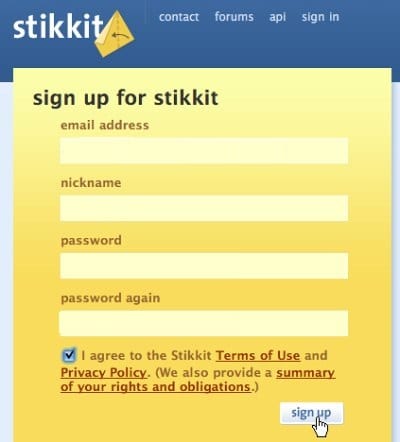
form with simple web design for registration
In every project where you will provide visitors with a service or tool, try to keep user requirements to a minimum. The less user action required to test a service, the more likely a random visitor will actually try it. First-time visitors are willing to play around with the service, don't fill out long web forms for an account they might not use in the future. Allow users to explore your site and discover your services without forcing them to share private data. It is not reasonable to force users to enter an email address to test the feature.
As Ryan Singer states – developer of the 37Signals team -, users would likely be willing to provide an email address if prompted after seeing it work, so that they would have an idea of what they would get in return.
Stikkit is a perfect example of an easy to use service, which requires almost nothing from the visitor, which is discreet and comforting. And that's what you want your users to feel. on your website. web.
Apparent, Bribes require more. However, registration can be done in less than 30 of seconds – because the form has horizontal orientation, the user doesn't even have to scroll the page.
Ideally, remove all barriers, don't ask for subscriptions or registrations first. Only one user registration is a sufficient impediment to user navigation and to reduce inbound traffic.
-
Intelligently manage user focus
Because websites provide both static content, as well as dynamic, some aspects of the user interface attract more attention than others. Evident, images are more attractive than text – just as bolded sentences are more attractive than plain text.
The human eye is a highly non-linear device, and web users can instantly recognize the edges, patterns and movements. This is why video ads are extremely annoying and distracting, but from a marketing perspective they do a perfect job of attracting users' attention.
Humanized perfectly uses the principle of focus. The only element that is directly visible to users is the word "free" which works attractively and attractively, but still calm and purely informative. Subtle hints give users enough information on how to learn more about the "free" product.
Focusing users' attention on certain areas of the site with a moderate use of visual elements can help your visitors get from point A to point B without thinking about how it should be done. The fewer questions visitors have, the better sense of direction they have and the more trust they can develop in the company the site represents. In other words: the less behind-the-scenes thinking has to happen, the better the user experience, which is primarily the purpose of use.
-
Strive for feature exposure
Modern web designs are usually criticized for their approach of guiding users through visually appealing steps 1-2-3, large buttons with visual effects etc. But, from a design perspective, these elements are actually not a bad thing. On the contrary, such guidelines are extremely effective, because they lead visitors through the website content in a very simple and user-friendly way.
Dibusoft combines visual appeal with clear website structure. Site-ul are 9 main navigation options, which are visible at first glance. However, the choice of colors could be too open.
Let the user clearly see what features are available is a fundamental principle of successful user interface design. It doesn't really matter how this is accomplished. What matters is that the content is well understood and visitors feel comfortable with how they interact with the system.
-
Use effective writing
Because the Web is different from print, it is necessary to adjust the writing style to the preferences and browsing habits of the users. Promotional writing will not be read. Long blocks of text without images and keywords marked in bold or italics will be skipped. Excessive language will be ignored.
Talk about business. Avoid cute or clever names, marketing induced names, company specific names and unknown technical names. For example, if you describe a service and want users to create an account, “sign up” is better than “start now!” which is again better than “explore our services”.
Eleven2.com gets straight to the point. No nice words, no exaggerated claims. Instead, a price: exactly what visitors are looking for.
An optimal solution for effective writing is to
- use short and concise sentences (get to the point as quickly as possible),
- use scannable layout (categorize the content, use multiple heading levels, use visuals and bulleted lists that break the flow of uniform blocks of text),
- use simple and objective language (a promotion doesn't have to sound like an ad; give users a reasonable and objective reason why they should use your service or stay on your site.)
-
Try as much as you can to keep things simple
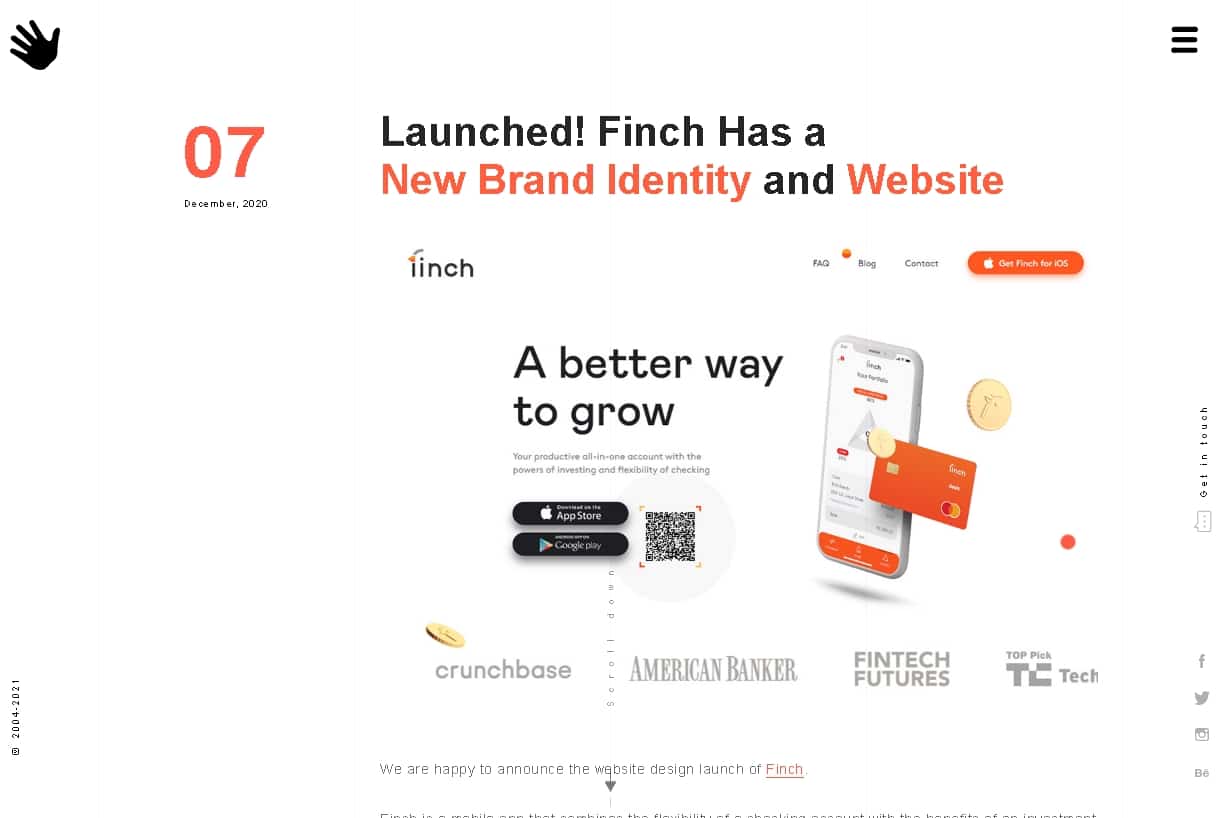
simple and intuitive web design
The "keep it simple" principle (SMALL) should be the primary focus of website design. Users are rarely on a site to enjoy the design; in addition, in most cases, they seek information despite the design. Strive for simplicity over complexity.
From the visitors' point of view, the best website design is pure text, no ads or other content blocks that exactly match the query used by visitors or the content they searched for. This is one of the reasons why a user-friendly print version of web pages is essential for a good user experience.
Finch clearly presents site information and offers visitors a range of options without cluttering them with unnecessary content.
-
Don't be afraid of white space
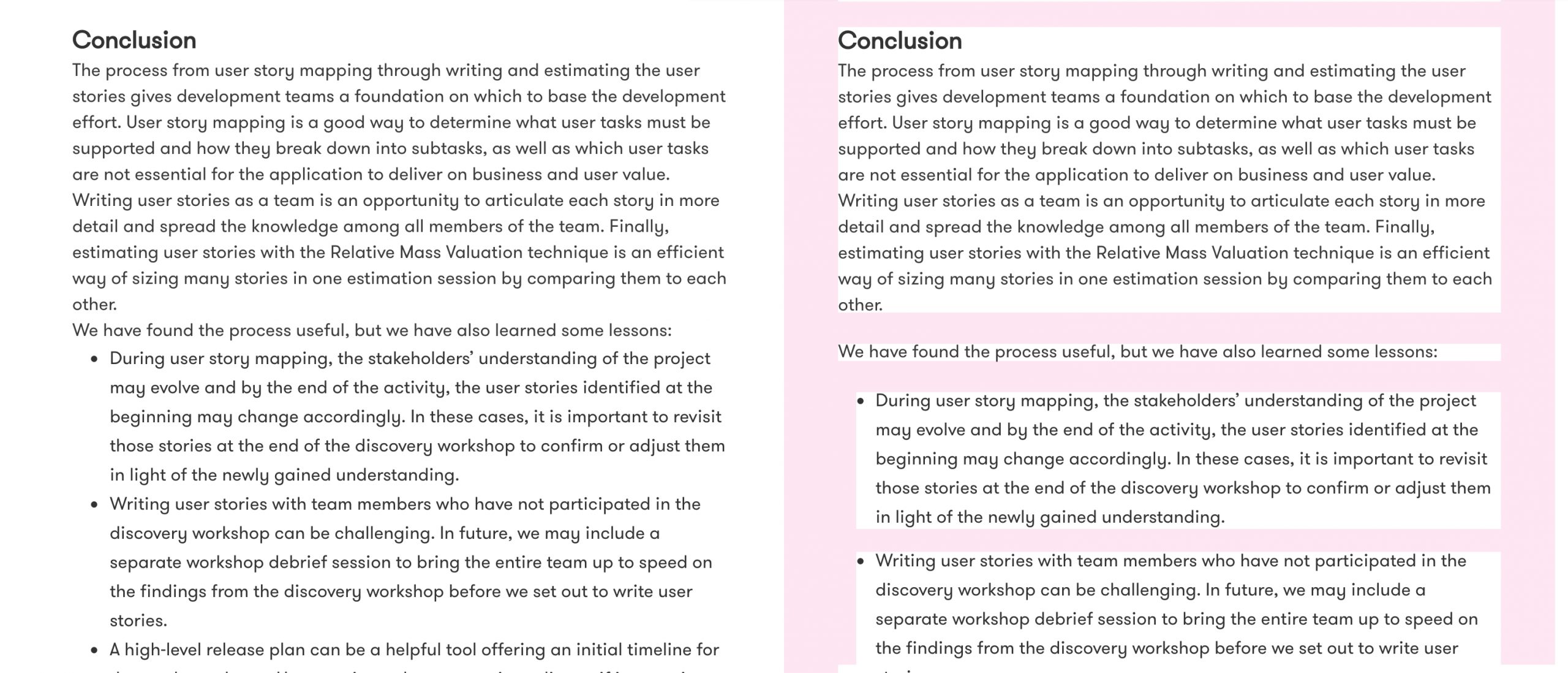
white spaces comparison for web design
Actually, it's very hard to overstate the importance of white space. Not only does it help reduce cognitive load for visitors, but it makes it possible to perceive the information presented on the screen. When a new visitor approaches a design aspect, the first thing it tries to do is scan the page and break the content area into digestible information.
Complex structures are harder to read, scan, analyzed and worked on. If you have a choice between separating two design segments with a visible line or white space, it's usually better to use the white space solution. Hierarchical structures reduce complexity (Simon's Law): the more you manage to give users a sense of visual hierarchy, the more your content. it will be easier to perceive.
White space is good. Cameron.io uses white space as its main design element. The result is a well scannable layout, which gives the content the dominant position it deserves.
-
Communicate effectively with "visible language"
In his works on effective visual communication, Aaron Marcus states three fundamental principles involved in using so-called "visible language" – the content that users see on a screen.
organize: provide the user with a clear and consistent conceptual structure. Coherence, screen layout, relationships and navigability are important organizing concepts. The same conventions and rules should apply to all elements.
Save up: do the most with the least amount of cues and visuals. Four major points to consider: simplicity, clarity, distinctiveness and emphasis. Simplicity includes only the elements that are most important for communication. Clarity: all components should be designed so that their meaning is not ambiguous. Distinctive character: the important properties of the required elements should be distinguished. Accent: the most important elements must be perceived easily.Communication: match the presentation to the user's capabilities. The user interface must maintain the balance of readability, readability, PRINTING, symbolism, multiple views and color or texture to communicate successfully. Use max. 3 character types at most 3 point sizes – maximum 18 words or 50-80 of characters per line of text.
-
Conventions are our friends
Conventional design of website elements does not result in a boring website. Actually, conventions are very useful because they reduce the learning curve, the need to learn how things work. For example, it would be a nightmare to use if all websites had a different visual presentation of RSS feeds. This is not so different from our ordinary life, where we tend to get used to the basic principles of how we organize data (folders) or how we shop (product placement).
With conventions you can earn trust, trust, user reliability and you can prove your credibility. Follow user expectations – understand what to expect from site navigation, the structure of the text, search placement etc.
A typical example from usage sessions is to translate the page into Japanese (assuming your users. web i don't know japanese, e.g, with Babelfish) and provide your testers with. of using a task to find something in the page of another language. If the conventions are well applied, users will be able to achieve a not too specific goal, even if I can't understand a word.
Steve Krug suggests that it's best to innovate only when you know you really have a better idea, but take advantage of conventions when you don't have any.
-
Test early, test often
This so-called TETO principle should be applied to every web design project because usability tests often provide essential information on significant problems and issues related to a given layout.
Test not too late, not too little and not for the wrong reasons. In the latter case, it is necessary to understand that most design decisions are local; that means you can't universally answer whether one aspect is better than the other, because you have to look at it from a very specific point of view (taking into account the requirements, interested parties, the budget etc.).
-
A few important points to remember:
according to Steve Krug, testing a user is with 100% better than testing one and testing one user early in the project is better than testing a 50 at the end. According to Boehm's first law, errors are most common during requirements and design activities and are more expensive the later they are removed. testing is an iterative process. That means you are designing something, you test it, you fix it and then test it again.
There may be issues that were not found during the first run, because users were basically blocked by other issues. usability tests always produce useful results. Either you will be directed to the problems you have, either you will be directed to the absence of major design flaws, which is in both cases a useful perspective for your project. according to Weinberg's law, a developer is not suited to test their code.
This is also true for designers. After working on a site for a few weeks, you can no longer observe it from a new perspective. You know how it is built and, therefore, you know exactly how it works – you have independent experts, and your site visitors. wouldn't have. Instead of conclusion: if you want a great site, you have to test.
Frequently asked questions related to web design
Web Design is the term used when we talk about creating web sites and other web applications. In Romania, the term web design is assimilated to the creation of web pages, web realization, web programming. Responsive Web Design is the part of web design that is based on the goal of optimally representing the design of web pages on all devices, mobil, tablet, desktop, display, tv or other types of graphic displays and take into account the resolution of each device on which it is displayed.What does web design mean??
What does Responsive Web Design mean??